 Ondofinance
 OUSG supports cash reserves, collateral, and settlement through tokenized Treasury fund exposure
Ondofinance OUSG fits cash management when an eligible holder wants short-term Treasury fund exposure with an onchain redemption route. Holding the token provides exposure to investment income, while supported collateral arrangements and transfers provide other uses for the holding. Its fit depends on when cash is needed, what asset the recipient accepts, and the applicable access and redemption limits.
· updated
Short-term Treasury exposure describes what a reserve holds; liquidity describes how it becomes a usable payment balance. The difference becomes visible when a deadline, collateral agreement, or recipient requirement calls for a particular asset.
Fund Value Versus Spendable Cash
OUSG provides fund exposure, while a USDC balance supplies the asset needed for a USDC-denominated payment. The portfolio provides exposure primarily to short-term U.S. Treasuries and also to government-sponsored enterprise securities. It invests through funds and keeps bank deposits and USDC for liquidity. Investment holdings contribute to returns; liquid balances support redemptions. The token represents a fund interest with a net asset value (NAV), which measures the value represented by that interest.
Cash management therefore distinguishes the holding’s NAV from the available balance in the asset needed for settlement. Transferring OUSG moves fund exposure. Redeeming it exchanges that exposure for the payout asset. USDY has a different note structure and separate eligibility rules, so shared Treasury-related terminology doesn’t make the products interchangeable. The relevant choice is between retaining an investment holding and obtaining the asset required for payment.
When Does OUSG Fit Idle Onchain Balances?
OUSG fits an idle balance when its holder wants Treasury-oriented yield and can accommodate the fund’s redemption conditions. Its cash-management purpose is holding capital between uses, with stablecoin redemption connecting the reserve to later spending. Imminent outflows create a different liquidity requirement from capital whose payment date allows time for redemption.
Income in the Token’s NAV
The fund updates OUSG’s NAV at the end of each business day. That value incorporates investment performance and accrued fees and expenses. Holding the token exposes the reserve to the fund’s return. A wallet’s token quantity and the holding’s dollar value measure different things; the NAV determines the value each token represents. Neither a token count nor the initial investment amount establishes the reserve’s later redemption value.
Net Return Over the Holding Period
Net return follows the fund’s performance over the period the capital remains invested. A displayed annual yield reflects past income over its measurement period. It doesn’t fix the return for a future holding period. Fund expenses and costs within underlying funds reduce the income reaching the holding. Short holding periods also leave less time for investment income to offset transaction costs.
Collateral and Bilateral Settlement
Pledging OUSG retains the borrower’s fund exposure, while a settlement transfer passes that exposure to the recipient.
Borrowing With Supported Collateral
OUSG can serve as yield-bearing collateral in lending arrangements that accept it. Borrowing provides liquidity while the pledged holding retains its OUSG exposure. The lending terms govern the available amount and repayment obligations. Fund eligibility alone doesn’t establish acceptance by a lending venue. Interest costs and collateral requirements affect whether borrowing meets the cash need. If the arrangement restricts pledged tokens, those restrictions also affect the balance available for transfer or redemption.
Settlement in Fund Interests
Bilateral settlement can use OUSG when both parties agree to accept the fund interest. OUSG tokens can transfer between investors who have completed Qualified-Access Funds onboarding. This moves a Treasury-oriented holding between approved participants without first converting it into a stablecoin balance. The recipient receives OUSG exposure. A payment agreement specifying USDC requires that different asset, even when both sides qualify to hold OUSG.
Recipient acceptance determines whether an OUSG transfer satisfies the obligation; wallet compatibility alone doesn’t establish acceptance.
Matching a Holding to Different Cash Needs
In this hypothetical comparison, an eligible, onboarded holder has OUSG; payment timing, lending availability, and recipients’ asset preferences are assumed.
Capital Reserved for Later Use
Capital with no immediate payment requirement stays in OUSG to retain exposure to the fund’s return. The holding’s token quantity and current per-token NAV show the reserve’s value; no conversion into a spending asset has taken place. This fits the reserve role while later withdrawals can meet the available redemption conditions. Moving the payment deadline forward changes the liquidity requirement, even if the fund holding stays the same.
Liquidity From Accepted Collateral
A cash need arises while the holder wants to keep the fund exposure, and a lending arrangement accepts OUSG. An approved and funded loan against the holding provides borrowed liquidity while the collateral retains exposure to the fund’s return. Completing the borrowing leaves a repayment obligation and the borrowed asset. That balance measures available liquidity, not income earned by the OUSG holding. This serves the cash need only while the lending terms permit the intended use and the collateral remains acceptable.
An OUSG Transfer or a USDC Payment
A recipient who accepts OUSG and has completed the required onboarding can receive the fund interest through a permitted transfer. A completed transfer settles the obligation in the agreed asset. A different recipient requires USDC. Sending OUSG would leave that obligation unpaid, making direct token settlement unsuitable. An available instant redemption delivers USDC when the OUSG redemption completes, subject to its minimum, limits, and payout liquidity. The resulting USDC balance supplies the asset required for that payment. A deadline tighter than the available redemption route favors a balance already held in the asset the recipient accepts.
Can OUSG Cover a Weekend USDC Payment?
OUSG’s instant redemption route can supply USDC on weekends when eligibility, minimums, available capacity, and payout liquidity permit redemption. Instant redemption exchanges OUSG and its USDC proceeds in one atomic transaction. The transaction therefore doesn’t require a separate wait for the next business day. Its completion establishes receipt of redemption proceeds. An onward payment or a bank withdrawal has its own completion requirements.
Global and individual limits reset every 24 hours, and usable capacity follows the lower remaining allowance. Available USDC can impose a further constraint. The instant transaction minimum is $5000. A reserve’s total NAV can therefore exceed the amount currently redeemable through this route. Available redemption capacity determines how much of the holding can fund a payment at that time.
Ondofinance OUSG: When Treasury Exposure Fits Cash Needs
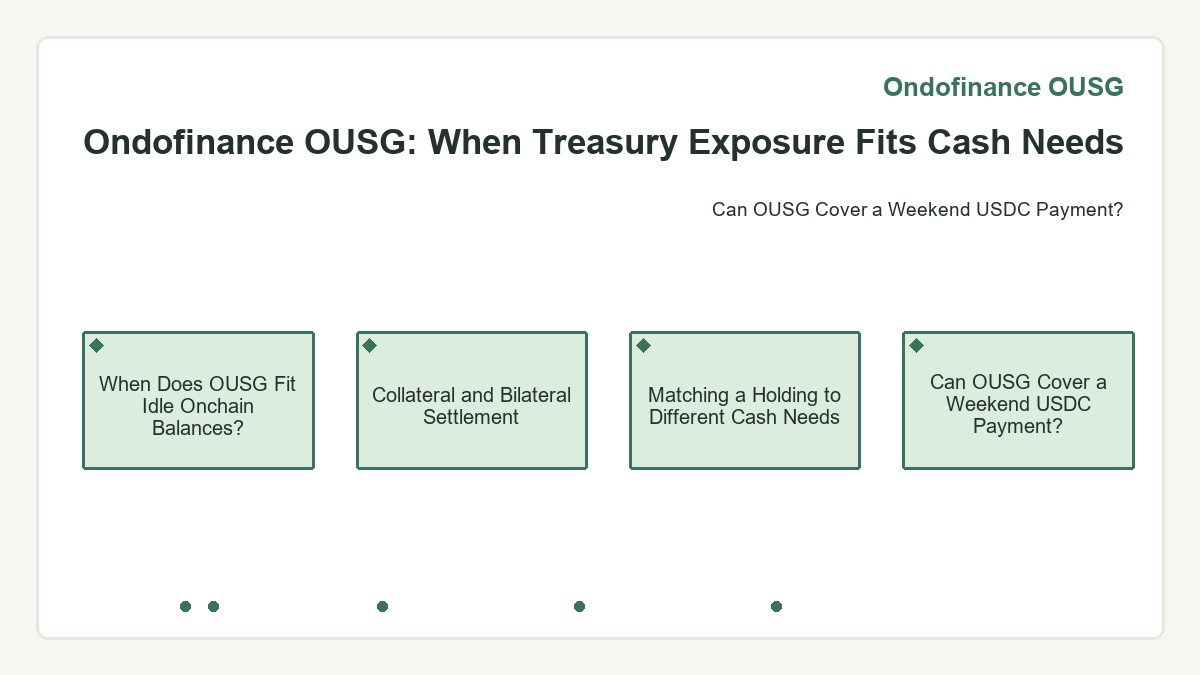
- When Does OUSG Fit Idle Onchain Balances?
- Collateral and Bilateral Settlement
- Matching a Holding to Different Cash Needs
- Can OUSG Cover a Weekend USDC Payment?
OUSG also offers daily USD liquidity alongside its instant USDC route. Non-instant redemptions normally have a $50,000 minimum and follow business-day processing. A smaller initial test redemption can be arranged with Ondo. Funds typically arrive the next business day if the holder sends the tokens for redemption before 4 p.m. Eastern Time. Sending them later typically adds another business day. Those processing expectations differ from instant settlement. A deadline falling before that processing completes requires liquidity from another available source.
Eligibility and Payment Requirements
OUSG’s access rules can exclude a use case before yield or timing becomes relevant. Qualified-Access Funds onboarding requires both accredited investor status and qualified purchaser status. The restrictions also govern who may receive the token. A recipient’s willingness to accept OUSG doesn’t establish eligibility. A transfer-based cash plan therefore needs an approved recipient as well as an agreement to settle in fund interests.
If bank dollars must arrive before a fixed cutoff, a USDC redemption alone hasn’t satisfied that payment requirement.
Questions people ask about Ondofinance OUSG
Can PYUSD Fund an OUSG Cash-Management Holding?
OUSG’s instant subscription route accepts PYUSD as well as USDC and returns OUSG to the investing wallet. Funding support and redemption support describe different transaction directions. The USDC instant redemption route has its own liquidity and limits; acceptance of PYUSD for an investment doesn’t establish PYUSD as the payout asset for that redemption route.
Does OUSG’s Management-Fee Waiver Remove All Reserve Expenses?
OUSG’s management-fee waiver runs until January 1, 2027. Fund expenses remain capped at 0.15% annually and underlying funds can charge expenses reducing OUSG’s returns. The waiver removes one fee layer without making Treasury exposure cost free or establishing the cost of every mint or redemption.
Who Receives OUSG’s Daily Accrual After a Settlement Transfer?
The holder at OUSG’s price update receives the day’s accrual through the updated token value. A transfer between eligible holders can therefore change who captures that update. Its timing relative to the update matters; the transfer date alone doesn’t establish whether the sender or recipient held the tokens when NAV changed.
How Does OUSG Account for Weekend Yield in a Cash Reserve?
OUSG’s Friday price update includes estimated yield for Friday and Saturday, while Monday’s update reflects Sunday and Monday. The update before a holiday includes estimated yield for that holiday. These accrual conventions differ from the 24/7 transaction schedule, so availability of an instant redemption doesn’t imply a new NAV update at that moment.
Are OUSG Cash-Management Holdings Available to Eligible U.S. Investors?
Eligible U.S. investors can hold OUSG after completing Qualified-Access Funds onboarding. Eligibility requires both accredited investor status and qualified purchaser status, along with applicable country and compliance requirements. Residence in the U.S. doesn’t itself establish access, and OUSG’s fund eligibility rules differ from USDY’s non-U.S. restrictions.