 Ondofinance
 USDY records yield in its reference price while rUSDY increases the holder’s token balance
Ondofinance USDY accumulates yield through a changing per-token reference price, while rUSDY reflects it through a rebasing token balance. Both forms represent value tied to USDY; rUSDY wraps USDY in a smart contract and targets a $1.00 reference value per unit. The choice affects how holdings appear in a wallet and how compatible applications account for them. Product eligibility, asset backing, and the redemption terms applicable to the holder’s tokens continue to govern both forms.
· updated
USDY, rUSDY, and the Wrapper
USDY provides the yield-bearing exposure, while rUSDY changes how a holder records that exposure through a wrapper contract. Accumulating USDY incorporates yield into its per-token reference price. Holding the same quantity can therefore represent increasing reference value as yield accrues. The rebasing form expresses that value in units with a $1.00 reference price. Its balance changes as the underlying USDY price updates.
The wrapper connects the two forms. It holds regular USDY and issues corresponding rUSDY, so the rebasing balance draws its value from locked USDY. Wrapping creates a different token representation of that holding. It doesn’t create an additional investment alongside it. This relationship also separates converting existing USDY from minting new USDY with a funding asset such as USDC.
Choosing a Form for Holding or Settlement
USDY and rUSDY suit different accounting tasks, with compatibility deciding whether the chosen form works in a particular custody or application setup.
Cash Management and Collateral
Accumulating USDY lets a position retain its token count while accrued yield changes its reference price. Its documented uses include cash management and collateral in smart contracts. Some custodians support only accumulating tokens, which can settle the choice before any preference about price or balance growth. A collateral application also needs to support the specific token and its valuation method; the rebasing form’s availability doesn’t establish that support.
Settlement and Exchange
rUSDY’s $1.00 reference-unit convention suits settlement or exchange arrangements designed around dollar-denominated balances. Yield appears through additional units, which changes how a wallet or application tracks the holding. Rebasing token support matters here because a fixed token count doesn’t describe the position over time. The applicable product restrictions continue to govern transfers, even when the receiving application can account for the balance.
Reading Reference Prices and Token Balances
Token quantity and reference value measure different aspects of a USDY holding, so either figure alone can give an incomplete income picture.
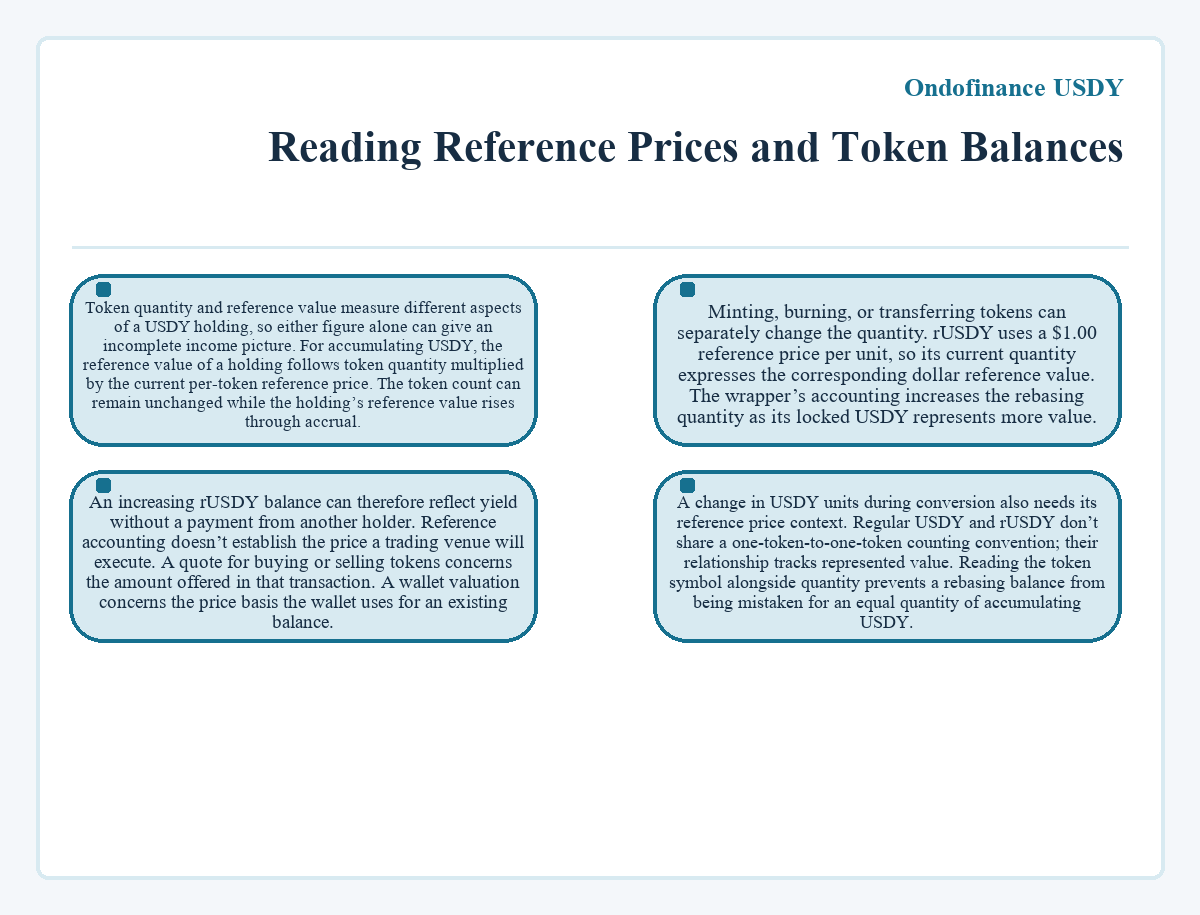
For accumulating USDY, the reference value of a holding follows token quantity multiplied by the current per-token reference price. The token count can remain unchanged while the holding’s reference value rises through accrual. Minting, burning, or transferring tokens can separately change the quantity.
rUSDY uses a $1.00 reference price per unit, so its current quantity expresses the corresponding dollar reference value. The wrapper’s accounting increases the rebasing quantity as its locked USDY represents more value. An increasing rUSDY balance can therefore reflect yield without a payment from another holder.
Reference accounting doesn’t establish the price a trading venue will execute. A quote for buying or selling tokens concerns the amount offered in that transaction. A wallet valuation concerns the price basis the wallet uses for an existing balance.
A change in USDY units during conversion also needs its reference price context. Regular USDY and rUSDY don’t share a one-token-to-one-token counting convention; their relationship tracks represented value. Reading the token symbol alongside quantity prevents a rebasing balance from being mistaken for an equal quantity of accumulating USDY.
Yield Accrual and Business-Day Updates
USDY accrues yield daily even though rUSDY balances don’t update on every calendar day. rUSDY rebases automatically when the USDY price updates each business day. A wallet’s unchanged rUSDY balance between updates doesn’t, by itself, establish that accrual stopped. Under the USDY and rUSDY rebasing terms, tokens covered by a redemption request submitted before the daily price update don’t accrue that day’s yield.
USDY Custody Through a Conversion Cycle
Converting USDY into rUSDY locks the accumulating tokens in a wrapper, which issues the corresponding rebasing balance to the holder’s wallet. The same contract supports the return to USDY by burning submitted rUSDY and releasing the underlying tokens. Any rebasing during the holding interval follows the USDY price-update schedule.
| Conversion Stage | Token Location and Control |
|---|---|
| USDY Before Conversion | The holder’s wallet contains unwrapped USDY. |
| USDY Locked for Conversion | The wrapper contract locks USDY to support the rebasing token. |
| rUSDY Issued | The wrapper mints corresponding rUSDY and sends it to the holder’s wallet. |
| Rebasing During the Holding Interval | USDY stays in the wrapper; the wallet’s rUSDY balance adjusts when the USDY price updates. |
| rUSDY Returned for Conversion | The holder sends rUSDY to the wrapper to convert back into USDY. |
| rUSDY Burned and USDY Returned | The wrapper burns rUSDY, unlocks the supporting USDY, and sends USDY to the holder’s wallet. |
Transferring rUSDY moves the rebasing token, while conversion back releases accumulating USDY.
Wrapped USDY and Total-Value Accounting
Wrapped USDY already supports the rUSDY representing it, so including both in an aggregate value calculation counts the same exposure twice. Total value across the two forms can combine the rUSDY quantity at its $1.00 reference value with unwrapped USDY valued at its reference price. An equivalent calculation values all USDY, wrapped and unwrapped, at the USDY reference price. These calculations concern the same underlying exposure; token counts from different forms aren’t directly additive.
What Does USDY’s Note Structure Mean for Holders?
USDY is a tokenized note whose backing and redemption arrangements depend on its issuance date and applicable offering terms, regardless of its accumulating or rebasing representation.
Issuance-Date Backing
Backing can include short-term U.S. Treasuries, shares of the iShares Short Treasury Bond ETF, or bank demand deposits. Which backing applies depends on the issuance date. The note gives its holder economic exposure under those terms, and holding USDY doesn’t provide a right to receive Treasury securities themselves. rUSDY’s wrapper retains the supporting USDY, so converting forms leaves that underlying note exposure in place.
Legacy and Current Terms
Ondo USDY LLC formerly issued USDY, and the USDY product moved under the Ondo Stocks umbrella on December 15, 2025. Current web-app purchases follow the terms for Ondo Stocks. Older issuance and redemption arrangements remain relevant to tokens governed by them.
Direct Access and Secondary-Market Eligibility
Qualifying non-U.S. individuals and organizations can access USDY, subject to jurisdictional and other eligibility restrictions. Direct minting follows onboarding, including the applicable identity and compliance checks. Choosing accumulating USDY or rUSDY doesn’t establish eligibility on its own. A token balance records possession, while the product’s direct transaction rules determine the holder’s access to minting or redemption.
Non-U.S. status alone doesn’t resolve every jurisdiction’s requirements. Offerings in the United Kingdom, Switzerland, and Singapore restrict access to qualified investors or professional clients, as applicable. Permitted transfers also remain subject to jurisdictional and other restrictions. Through the current Ondo Stocks purchase route, holding acquired tokens doesn’t complete the onboarding needed for direct redemption.
Yield Rates and Accumulated Income
The applicable token yield rate governs how yield adds to USDY’s reference price; rUSDY translates that price change into its balance. Rebasing calculations use the token yield rate for the relevant month. That rate is a separate input from the holding’s already accumulated value.
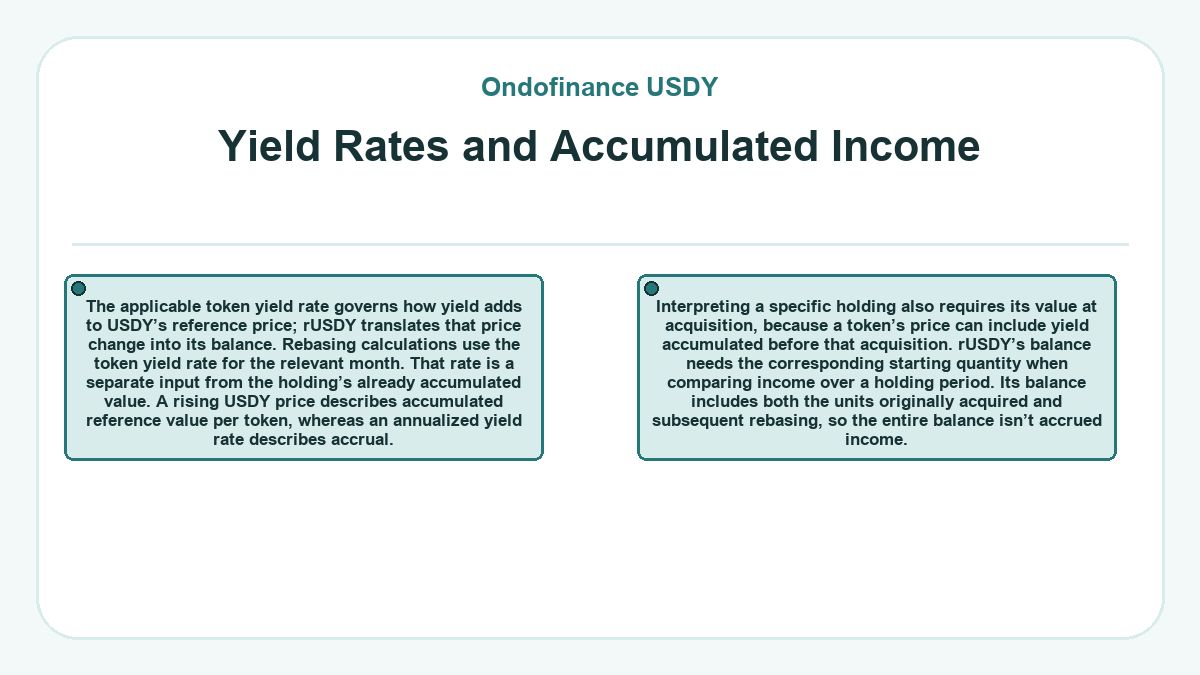
A rising USDY price describes accumulated reference value per token, whereas an annualized yield rate describes accrual. Interpreting a specific holding also requires its value at acquisition, because a token’s price can include yield accumulated before that acquisition. rUSDY’s balance needs the corresponding starting quantity when comparing income over a holding period. Its balance includes both the units originally acquired and subsequent rebasing, so the entire balance isn’t accrued income.
Redemption Methods and Issuer Scope
For USDY governed by Ondo USDY LLC’s redemption arrangements, bank-wire dollar redemptions go only to non-U.S. bank accounts and require bank details. USDY redemption for USDC through Ondo Global Markets (BVI) Limited follows the Ondo Stocks route. The token form alone doesn’t select the available payout method.
Converting rUSDY back into USDY changes the token representation. Redeeming a token under its applicable terms pays out through a supported settlement route. These operations have different outcomes, so a conversion option doesn’t establish cash redemption access. The holder’s eligibility and relevant issuance terms govern the redemption.
Wallet, Custodian, and Application Support
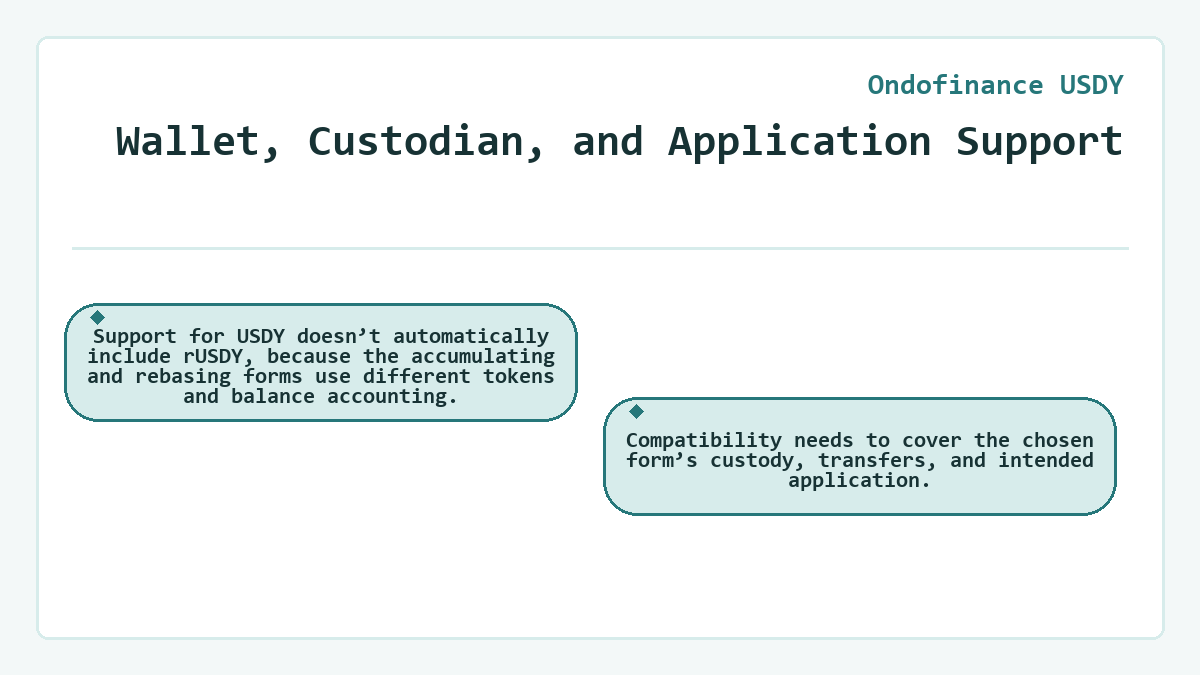
Support for USDY doesn’t automatically include rUSDY, because the accumulating and rebasing forms use different tokens and balance accounting. Compatibility needs to cover the chosen form’s custody, transfers, and intended application.
Custody and Balance Accounting
A wallet or application holding rUSDY needs to track its current rebasing balance, including changes unrelated to ordinary transfers. Software treating its token quantity as permanently fixed can’t describe the rebasing holding correctly. An accumulating holding instead needs a USDY price input to express its reference value.
Collateral and Payment Support
DeFi use requires support from the particular protocol; a token’s transferability alone doesn’t make it acceptable collateral. Payment and settlement integrations similarly need to handle the selected form. In a settlement arrangement denominating balances in rebasing units, the relevant accounting reference is rUSDY at $1.00 per unit.
Things people ask about Ondofinance USDY
Is rUSDY Available on Every Network Supporting USDY?
USDY network support doesn’t automatically include rUSDY. Support for the rebasing form includes Ethereum and Mantle, while USDY’s network list also includes Solana, Sui, and Aptos.
Does Converting Between USDY and rUSDY Involve Slippage?
USDY and rUSDY support conversion between their forms without slippage. This concerns exchanging the two representations of the same underlying value. Buying or selling tokens on a secondary market is a different operation, with its own execution price. Slippage and separately charged transaction costs are also different concepts, so a no-slippage conversion shouldn’t be read as a blanket fee exemption.
When Does Freshly Minted USDY Begin Earning Interest?
USDY begins earning interest once its investment transaction has been processed. Completing onboarding or submitting a transaction doesn’t, by itself, mark that point. This timing concerns acquisition of USDY; the automatic adjustment of an rUSDY balance follows the underlying USDY price-update schedule.
Can a USDY Purchase Be Funded by Bank Wire Instead of USDC?
USDY Basics describes bank-wire funding for deposits of $100,000 or more under its USDY investment arrangements. After onboarding, contact Ondo support for bank-wire funding details. It funds an investment in USDY, distinct from converting existing USDY into rUSDY. Current web-app purchases follow the Ondo Stocks terms.
What Minimum Applies to support-assisted USDY Minting and Redemption?
The support-assisted USDY minting and redemption route on Sui, Aptos, Stellar, XRP, and Noble has a $5000 minimum. This minimum applies to that network route, rather than setting a minimum for every USDY acquisition, conversion, or redemption method.